Guide
Best Mixing Bowls For Christmas Baking
Our honest guide to best mixing bowls for christmas baking — what actually matters, what to skip, and how to choose well.

Our honest guide to best mixing bowls for christmas baking — what actually matters, what to skip, and how to choose well.
Best Overall
 Best Premium
For Christmas baking, the best mixing bowls are a practical mix: stainless steel for everyday prep, heat-safe glass for melting and make-ahead work, and ceramic or plastic in supporting roles depending on how you bake. What matters most is less about a festive pattern and more about depth, stability, and having the right sizes on hand so cookie dough, cake batter, and frosting stay in the bowl instead of all over the counter.
Holiday baking asks more of a bowl than a quick weekday recipe. I want enough headroom for flour and sugar to move around, sides deep enough to contain vigorous whisking, and a shape that stays put when I am creaming butter or folding in dry ingredients. A medium bowl around 2 to 4 quarts handles most jobs, while larger doughs and doubled batches are easier in something 5 quarts or larger. Capacity matters, but shape matters just as much: a very wide, shallow bowl tends to feel roomy while still making a mess.
If I were choosing one material to do the most work in December, it would be stainless steel. It is light, durable, nonporous, and well suited to the repetitive prep that holiday baking usually involves: mixing cookie dough, whipping cream, holding measured ingredients, and moving from one batch to the next without much fuss.
WHYSKO Stainless Steel Mixing Bowls Set, 3-Piece with Silicone Base
Shop at Amazon →Stainless steel is also useful when temperature matters. A chilled metal bowl helps with whipped cream and egg whites, and it responds quickly when I need ingredients to cool down or warm slightly. It is a reliable choice for acidic ingredients too, which matters in recipes with citrus, molasses, or fruit fillings.
The tradeoff is simple: stainless steel should not go in the microwave. If part of your Christmas baking routine involves melting butter or warming chocolate in the same bowl, you will still want another material nearby. For general food-contact guidance and care, the USDA’s safe food handling basics are a good reminder that clean, nonporous surfaces make prep simpler and safer.
What I look for in a stainless steel bowl is a broad enough base to feel steady, plus enough depth to keep flour from escaping during mixing. A lightweight bowl is convenient, but if it skids across the counter every time you whisk, it stops being convenient quickly.
Glass earns its place during Christmas baking because it handles jobs stainless steel cannot. It is useful for melting butter, warming chocolate gently, and refrigerating a filling or dough in the same bowl. I also like that glass makes it easy to spot streaks of flour, unmixed butter, or color changes in chocolate and caramel.
The key here is heat-safe glass, used according to its care instructions. Not every bowl should go from fridge to microwave or from hot ingredients to a cold countertop. Thermal shock is the main concern: sudden temperature changes can crack glass, even when it is otherwise sturdy. The U.S. Consumer Product Safety Commission’s kitchen safety guidance is a helpful reminder to treat hot cookware and bakeware carefully, especially during busy holiday prep.
For chocolate, glass is one of my preferred options because it can go into the microwave if the bowl is rated for it. I still heat in short intervals and stir often. The bowl must be completely dry, since even a little water can cause chocolate to seize.
The downsides are weight and breakability. A large glass bowl full of batter can be awkward to pour from, and if your sink area gets crowded during holiday baking, glass takes a bit more care than steel.
Ceramic bowls can be very helpful at Christmas, especially if you want a bowl that moves from mixing to the table gracefully. Their weight gives them a grounded, stable feel, which is useful for stirring thick frostings, resting dough, or mixing fruit fillings without the bowl shifting around.
Rorence Stainless Steel Mixing Bowls Set with Lids,1.5,3 & 5 Qt,Light Blue
Shop at Amazon →I think ceramic makes the most sense as a secondary material rather than the only one in the kitchen. It is often heavier to lift and pour, and care varies more from bowl to bowl. Some glazed ceramic is microwave safe, some is oven safe, and some is decorative first and functional second. The FDA’s home food safety guidance is a solid general reference for keeping food-contact surfaces clean and in good condition, which matters if a glaze is worn, chipped, or crazed.
If you use ceramic for holiday baking, inspect it before making meringue or whipped cream. Grease trapped in scratches or damaged glaze can interfere with foaming. I also avoid sudden temperature swings here just as I do with glass.
Plastic is not my first choice for heavy-duty mixing, but it can be genuinely useful in a Christmas baking setup. It is lightweight, easy to carry, and often practical for ingredient prep, transporting cookies, or chilling dough when a bowl comes with a lid.
This is the material I reserve for lower-heat tasks and general organization. It works well for measured ingredients, toppings, sprinkles, or dough that needs to rest in the refrigerator. For bakers working with kids, plastic can also be the least stressful option.
The limits are worth paying attention to. Heat tolerance varies widely, so I would not assume a plastic bowl can handle hot butter or microwave use unless it is clearly labeled for that purpose. Scratched plastic can hold onto odors, stains, and greasy residue more easily than steel or glass, which makes it less appealing for peppermint-heavy mixtures, strongly spiced doughs, or oily fillings.
A useful bowl collection does not need to be huge, but it should cover the jobs that holiday baking creates.
For most Christmas cookie recipes, a deep bowl in the 3- to 5-quart range is the sweet spot. It gives enough space to incorporate flour without sending it over the rim, and it is still manageable to lift and scrape clean.
A few design details make a real difference during a long baking day. Non-slip bases help keep a bowl planted while mixing. Pouring rims are useful for transferring batter or glaze neatly. Handles can help on larger bowls, but only if there is enough room to grip them comfortably.
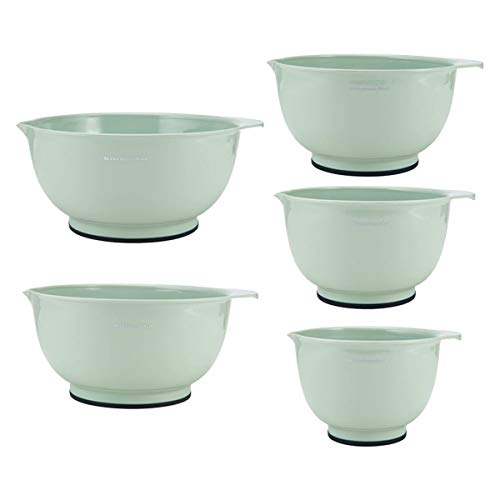
KitchenAid Classic Mixing Bowls, Set of 5, Pistachio
Shop at Amazon →Nesting storage is another feature I value more in December than at any other time of year. When several bowls are in rotation at once, it helps to keep sizes together and easy to grab. If lids are part of the set, I want them fully dry before storing so moisture does not get trapped.
The most common mistake is using a bowl that is too shallow. Even if the listed capacity seems large enough, a shallow shape makes flour fly and folding awkward. A deeper bowl usually gives cleaner results and a calmer workflow.
Another frequent problem is using the wrong material for heat. Stainless steel does not belong in the microwave, and decorative ceramic should not be assumed safe for hot chocolate melting or oven use. Always check the bowl’s instructions before exposing it to heat.
I also think it helps to stay ahead of cleanup. Holiday baking can fill a sink fast with bowls, beaters, and sheet pans. Rinsing bowls promptly and soaking dried dough before it hardens saves time and protects finishes from harsh scrubbing later.
Good bowl care is not complicated, but it does affect results. Bowls used for meringue, whipped cream, or buttercream should be thoroughly clean and fully dry. Any hidden grease can interfere with texture.
For dried-on dough, I prefer a soak in warm water over aggressive scraping. Nonabrasive sponges are gentler on stainless steel, glass, and glazed ceramic. If a bowl develops lingering odors, dish soap followed by a baking soda paste can help, especially on plastic.
And for glass or ceramic, I always come back to the same rule: avoid sudden temperature changes. Let hot bowls cool gradually, and do not place them on very cold or wet surfaces right away.
A deep 3- to 5-quart bowl works well for most cookie dough. Go larger if you often double recipes or make especially stiff doughs.
Yes. Lids are handy for chilling cookie dough, holding fillings, and storing prepped ingredients without transferring them to another container. Just make sure both bowl and lid are completely dry before sealing.
Some heat-safe glass and some ceramic bowls may be oven safe, but that depends on the specific piece. Stainless steel can tolerate heat in many cases but is not microwave safe. The safest approach is to follow the bowl’s own care instructions instead of guessing by material alone.
They can be, if the bowls are genuinely useful. I would prioritize practical sizes, stable shapes, and easy-care materials before decorative appeal.
The best mixing bowls for Christmas baking are the ones that match the job: stainless steel for daily mixing, heat-safe glass for warming and chilling, and ceramic or plastic where their strengths make sense. If the bowl is deep, steady, and easy to care for, holiday baking tends to go much more smoothly.

Paige Gilmore
Founder of Stripes & Willows — recipe creator, food photographer and stylist. Every guide is written to make honest, useful kitchen decisions easier.
More about Stripes & Willows →This page contains affiliate links. If you buy through them, Stripes & Willows may earn a commission at no extra cost to you — it never affects what we recommend.