Guide
Best Silicone Baking Mats For Christmas Cookies
Our honest guide to best silicone baking mats for christmas cookies — what actually matters, what to skip, and how to choose well.

Our honest guide to best silicone baking mats for christmas cookies — what actually matters, what to skip, and how to choose well.
 Best Value
 Amazon
Yes, silicone baking mats can be a very good choice for Christmas cookies, especially if you want easy release, less mess, and a reusable surface for batch after batch. The catch is that they do not bake exactly like parchment or bare metal. In my kitchen, the best results come from treating a silicone mat as its own baking surface: excellent for soft sugar cookies, gingerbread, shortbread, and sticky doughs, but not always the first pick for cookies that need very crisp, deeply browned bottoms.
Silicone changes the way heat reaches the dough. Because the mat creates a barrier between the baking sheet and the cookie, the bottoms tend to heat more gently. That usually means cookies release cleanly and brown less aggressively underneath, but it can also mean a bit more spread before the edges set.
Great Jones Sweet and Savory Baking Mats
Shop at Great Jones →That tradeoff matters most with butter-rich holiday cookies. A useful comparison of pan linings and cookie spread explains why cookies can turn out thinner on different baking surfaces. On silicone, I expect paler bottoms and a slightly softer base, which is often exactly what I want for tender cutouts and soft sugar cookies.
Cookies that usually do well on silicone mats include:
Where silicone can be less helpful is with very thin, crisp, or lace-like cookies that rely on stronger bottom heat. If the recipe is all about snap, deep browning, or a firmer underside, parchment is often the better place to start.
If I had to put it simply, silicone is best when I care most about release and repeatability, and parchment is best when I care most about browning and crisp texture. Neither is automatically better. It depends on the cookie.
Silicone mats are useful for rolled cookies with cut edges you want to keep tidy, doughs that tend to stick, and big baking days when you would rather not keep pulling fresh sheets of parchment. The surface stays flat, the cookies lift off neatly, and cleanup is usually straightforward.
Parchment still earns its place. It allows a little more direct heat and often gives cookies a firmer base. It is also handy when I want to lift a whole batch off the hot pan at once to stop carryover baking. A general guide to silicone baking mats outlines the typical construction and use of these mats, but the real decision comes down to texture.
For a new Christmas cookie recipe, I think it makes sense to bake the first batch on the surface the recipe suggests. If the recipe gives no preference, I use silicone for softer cookies and parchment for crisper ones.
A good result starts with fit. The mat should lie completely flat inside the baking sheet, without buckling in the corners or hanging over the rim. If it shifts or curls, the cookies can bake unevenly.
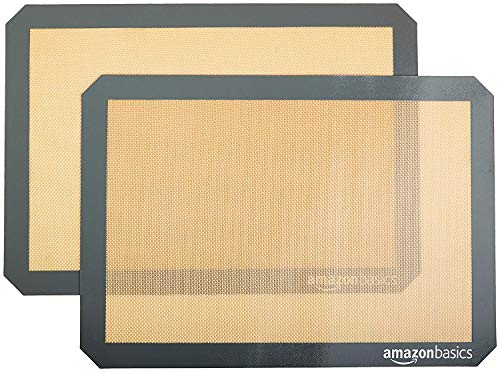
Amazon Basics Silicone Rectangular Baking Mat, Non-Stick, Reusable, Dishwasher Safe, Food Safe, Heat Resistant, 16.5" x
Shop at Amazon →I always place the mat on a sturdy baking sheet, never directly on the oven rack. Silicone needs the support of the pan underneath, and the metal sheet is part of how the cookies heat and set.
For the most even baking:
If a favorite recipe spreads too much on silicone, I do not jump straight to a hotter oven. Usually it is better to chill the dough longer, give the cookies more room, and test a small batch first. Raising the temperature too much can brown the tops before the centers bake through.
Silicone mats can also add a minute or two to the bake, though not always. I use time as a guide and watch for set edges, a matte surface, and the texture the recipe is aiming for. An article on cookie spread and pan lining is a helpful reminder that the baking surface is not a minor detail; it can change the final shape and texture more than many people expect.
The most important feature is simple: it should fit the pan you actually use. Half-sheet and quarter-sheet pans vary a little, so measuring the inside flat base of the pan is more reliable than assuming every mat labeled for that size will fit perfectly.
I would look for:
Smooth mats are the most versatile for Christmas cookies. Perforated styles can make sense for certain pastry applications, but for cutouts, drop cookies, shortbread, and decorated holiday baking, a smooth surface is usually the easiest and most predictable option.
Before the holiday season starts, it is worth checking for cracks, fraying, bubbling, or any sign that the internal reinforcement is exposed. A damaged mat is not one I would keep in rotation.
Silicone is easy to clean, but it does have a habit of holding onto grease if it is washed too casually. Even when a mat looks clean, it can still have a thin film that affects how later batches bake and release.
Vinino 1Pack Silicone Muffin Pan for Baking with Metal Reinforced Frame, 12 Cup Regular Size Cupcake Pan, BPA Free Silic
Shop at Amazon →I wash silicone mats with warm water, mild dish soap, and a soft sponge after they cool. For stubborn residue, a simple paste of baking soda and water can help lift grease without being abrasive. This cleaning guide for silicone baking mats makes the same point: gentle but thorough cleaning matters.
A few mistakes are worth avoiding:
Cooking spray is a common misstep. Silicone is already nonstick, and extra oil can leave behind a tacky layer that attracts crumbs and old grease. I skip it for cookies.
Once clean and fully dry, the mat is best stored flat or loosely rolled. Tight folds can weaken it over time, and holiday baking is hard enough without fighting a mat that refuses to lie flat in the pan.
Yes. Silicone mats work especially well for soft sugar cookies, gingerbread, shortbread, and sticky doughs that benefit from clean release and gentler bottom browning.
Sometimes, yes. Because silicone slows heat transfer from the pan, cookies may need a little more time for the edges and bottoms to set. I watch color and texture more closely than the clock.
Silicone is better for easy release, reuse, and softer bottoms. Parchment is often better for cookies that need more browning, a firmer base, or a crisper finish.
They are designed for baking when used according to the manufacturer’s temperature limit and placed on a baking sheet. I would stop using one if it showed cracking, bubbling, or exposed reinforcement.
I would skip it for broiling, direct heat exposure, sharp-tool work, and cookies where deep browning or extra crispness on the bottom is essential.
Silicone baking mats are a smart choice for many Christmas cookies, as long as you expect slightly different spread and browning than you get from parchment. For soft, tidy, easy-release holiday baking, they are hard to beat; for crisp, deeply browned cookies, parchment often still has the edge.

Paige Gilmore
Founder of Stripes & Willows — recipe creator, food photographer and stylist. Every guide is written to make honest, useful kitchen decisions easier.
More about Stripes & Willows →This page contains affiliate links. If you buy through them, Stripes & Willows may earn a commission at no extra cost to you — it never affects what we recommend.