Guide
Best Measuring Cup Sets For Thanksgiving Baking
Our honest guide to best measuring cup sets for thanksgiving baking — what actually matters, what to skip, and how to choose well.

By Paige Gilmore · Updated 2026-09-09
Our honest guide to best measuring cup sets for thanksgiving baking — what actually matters, what to skip, and how to choose well.
 Best Value
 Best Premium
Also Great
Best Premium
Also Great
For Thanksgiving baking, the best measuring cup setup is not one all-purpose set. I’d choose sturdy dry measuring cups, one clear liquid measuring cup, and a full set of measuring spoons. That combination is the most practical way to handle flour for pie crust, brown sugar for cookies, melted butter for streusel, and all the small spice and leavener measurements that holiday baking depends on.
Holiday recipes ask a lot from measuring tools. Pie dough needs flour measured lightly and evenly. Brown sugar needs to be packed. Custards, gravy components, and melted butter need a vessel you can read from the side and pour from cleanly. Spices and baking powder need spoons that fit inside jars and can be leveled neatly.
King Arthur Baking Company Lightweight Measuring Cups, BPA- And PFAS-Free, 5-Piece Set, Precision Measures, For Baking A
Shop at Amazon →That’s why I separate the job into three categories:
Using each tool for its intended purpose makes recipes more consistent and cuts down on small errors that add up in baking.
The basics matter more than extras. I look for readable markings, a level rim on dry cups, solid handle construction, and sizes I’ll use constantly in November and beyond.
For dry cups, the essential sizes are 1/4 cup, 1/3 cup, 1/2 cup, and 1 cup. For liquids, a 1- or 2-cup vessel covers most baking tasks, and a larger one can be useful for stock or bigger batches of milk and cream. Measuring spoons should include at least 1/4 teaspoon, 1/2 teaspoon, 1 teaspoon, and 1 tablespoon.
Markings matter, too. Engraved or molded labels tend to stay readable longer than lightly printed ones. Handles should feel secure, and the cup should sit or rest without wobbling. If pieces nest neatly or store together in a way that suits your kitchen, that helps during a busy prep day when you do not want to hunt for the missing 1/3 cup.
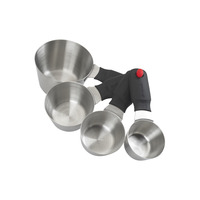
Stainless steel is the most practical material for dry measuring cups. It is sturdy, holds its shape well, and gives you a clean, flat rim for leveling flour or sugar. That level rim is especially useful for pie crust, crumb toppings, and cookie dough, where too much flour can change the texture quickly.
GoodCook Touch 4-Piece Stainless Steel Assorted Measuring Cup Set
Shop at Instacart →Also at AmazonI also think steel makes sense for packed brown sugar because the cup stays rigid while you press the sugar in. When you invert it, the packed sugar should hold the shape of the cup if measured correctly.
The limitation is visibility. Steel is not ideal for side-reading liquids, so I would not rely on it alone if you bake often. It works best as part of a mixed setup with a clear liquid cup nearby.
Care is straightforward: wash thoroughly, dry fully before nesting, and pay attention to any shallow engraved markings where flour can cling. Moisture trapped between stacked pieces can leave spotting or residue.
For liquid ingredients, glass is the most useful option because you can see the measurement line from the side. That matters when you are measuring milk for custard, stock for gravy, or melted butter for a filling. A spout also gives you more control when pouring into a mixing bowl or saucepan.
The right technique matters here. Set the cup on a flat counter and read the measurement at eye level. That gives you a more accurate view of the liquid line than holding it in your hand. The distinction between dry and liquid measuring tools is explained clearly in this King Arthur Baking guide.
Glass does need more careful handling. Check the maker’s temperature guidance before using it with hot ingredients, and avoid sudden temperature changes. If you measure melted butter, it also helps to wipe out the grease with a paper towel before washing so the residue does not coat everything else in the sink or dishwasher.
Plastic measuring cups can be very handy in a crowded kitchen. They are light, easy to grab quickly, and less nerve-racking around hard tile floors or a sink full of heavy cookware. For some cooks, that convenience is reason enough to keep a plastic liquid cup in regular rotation.
Martha Stewart Richburn 4-Piece Gold Stainless Steel Measuring Cup Set – Durable and Stylish Kitchen Measuring Tools for
Shop at Amazon →Still, plastic has trade-offs. Over time, markings may become harder to read, surfaces can scratch, and strong ingredients may leave stains or odors behind. High heat can also be a problem, especially if the material is exposed to very hot ingredients or an aggressive dishwasher cycle.
If you use plastic, clear markings and a stable shape are the big things to watch. Once lines fade or the vessel no longer sits evenly, it is less dependable for baking.
Ceramic measuring cups can look charming, but for Thanksgiving baking I do not think they are the most practical choice. They are heavier, can chip, and usually do not give you the visibility you want for liquid measuring.
For dry ingredients, they can work if the sizing is clearly marked and the rim is easy to level. But for an all-around holiday baking setup, ceramic tends to prioritize appearance over ease and precision. I would keep it as a secondary option rather than the core set.
Even a good set will not help much if the technique is off. The most common holiday baking mistakes are simple: scooping flour directly from the bag, under-packing brown sugar, and trying to use one kind of cup for everything.
Loosen the flour first, spoon it into a dry measuring cup, then level it with a straight edge. Scooping directly from a compacted bag can add too much flour. Serious Eats explains why this difference matters so much in baking. If a recipe gives weights, I’d use a kitchen scale every time.
Spoon it into a dry cup and press firmly until packed. When turned out, it should hold the shape of the cup. That is what recipes mean by packed brown sugar.
For honey, molasses, or syrup, a light film of neutral oil in the cup can help the ingredient release more cleanly if the recipe allows for it. A flexible spatula helps get the last bit out.
Measure in a clear liquid cup on the counter, then read the line at eye level. Dry cups are awkward for liquids and easy to spill; liquid cups are awkward for leveling flour. Swapping them creates avoidable inaccuracy.
Thanksgiving prep is much easier when your measuring tools are readable, clean, and all in the same place. I like to wash sticky or greasy pieces right after use instead of letting syrup or butter harden.
To keep a set in good shape:
Storage style is mostly personal. Nested cups save drawer space. Spoons on a ring stay together, though you may need to remove several to use one. An accessible system matters more than a fancy one, especially during big baking weekends.
Yes. Dry cups are designed to be filled to the top and leveled, while liquid cups are designed to be read from the side with space at the top to prevent spills. Using each for its intended purpose makes baking more accurate.
For dry ingredients, the core set is 1/4 cup, 1/3 cup, 1/2 cup, and 1 cup. For liquids, a 1- or 2-cup measure is the most useful place to start. Measuring spoons should cover at least 1/4 teaspoon through 1 tablespoon. Standard sizes are outlined in this measuring cup size guide.
For dry baking ingredients, I think stainless steel is usually the stronger choice because it resists staining, keeps its shape, and gives you a crisp rim for leveling. Plastic is lighter and less fragile, but the markings and shape need to stay in good condition to remain reliable.
Spoon the flour into a dry measuring cup, then level it with a straight edge. Do not scoop directly from the bag. If the recipe includes weights, use those for the most consistent result.
Yes, as long as the cup is rated for that kind of use and you avoid sudden temperature changes. Set it on a stable surface, read carefully, and pour through the spout.
The best measuring cup sets for Thanksgiving baking are really a small team: dry cups, a clear liquid cup, and measuring spoons. If I were choosing just on practicality, I’d lean on stainless steel for dry ingredients and a clear glass or sturdy plastic cup for liquids, then keep them clean, readable, and close at hand for every pie, cookie, and casserole week throws at me.

Paige Gilmore
Founder of Stripes & Willows — recipe creator, food photographer and stylist. Every guide is written to make honest, useful kitchen decisions easier.
More about Stripes & Willows →This page contains affiliate links. If you buy through them, Stripes & Willows may earn a commission at no extra cost to you — it never affects what we recommend.
