Guide
Demeyere Cookware Materials
Our honest guide to Demeyere cookware materials — what actually matters, what to skip, and how to choose well.
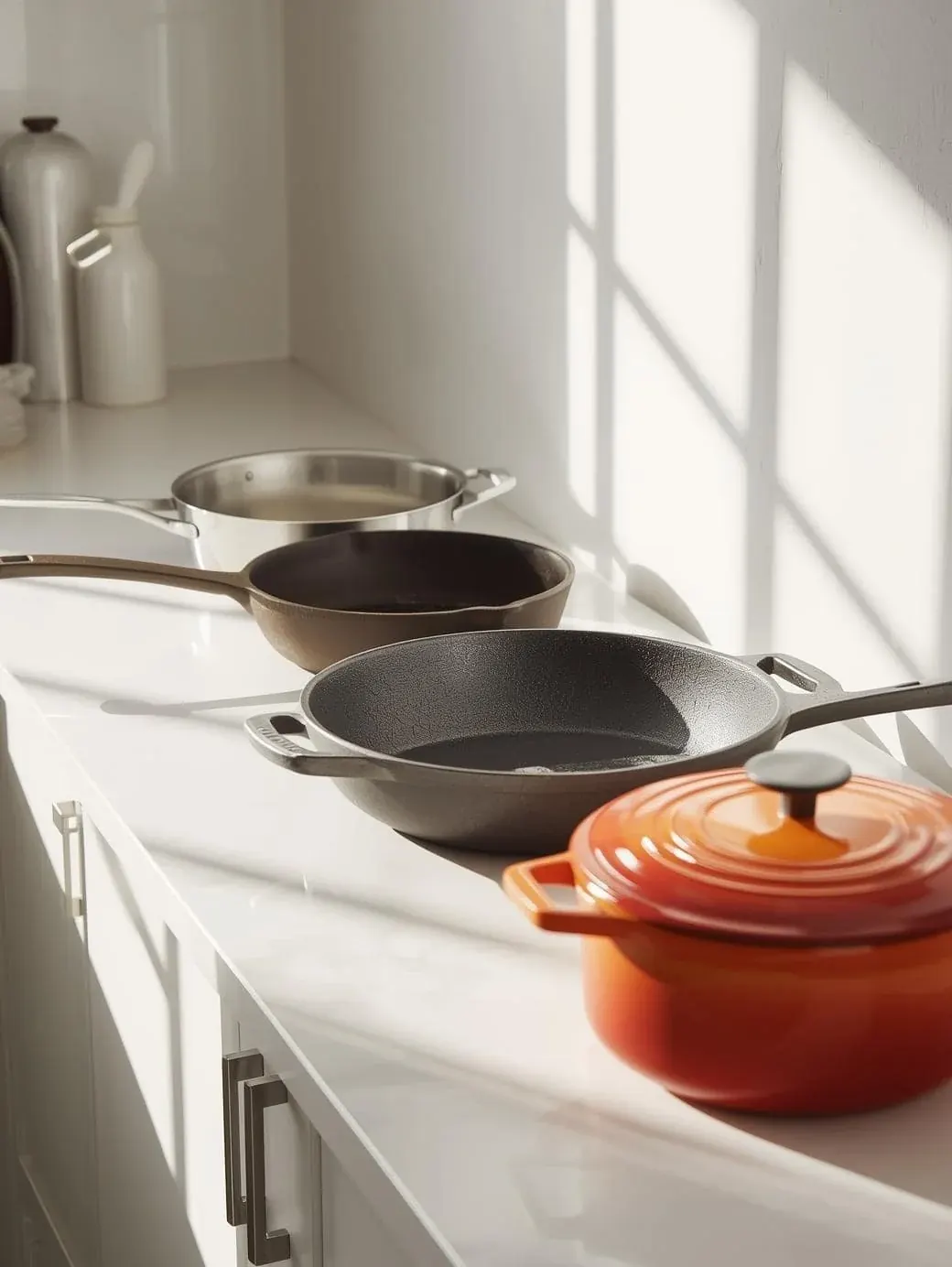
Our honest guide to Demeyere cookware materials — what actually matters, what to skip, and how to choose well.
 Best Overall
 Best Premium
Demeyere cookware is mainly built from stainless steel and aluminum, with some constructions adding magnetic stainless steel for induction and, in selected pieces, copper for faster response. In practical terms, that means the cooking surface is usually durable stainless steel, while the hidden layers underneath do the work of spreading and managing heat. If you want the short answer: the materials are chosen for control, evenness, and longevity, and the best fit comes down to how you cook and what kind of maintenance you’re willing to do.
In most Demeyere stainless cookware, stainless steel is the food-contact surface. Many pieces use 18/10 stainless steel, which refers to an alloy with chromium and nickel added for corrosion resistance and durability. That matters because this is the layer you cook on, scrub, and rely on for browning.
Demeyere Atlantis 7-Ply Stainless Steel Fry Pan with Helper Handle, 11"
Shop at Amazon →For everyday cooking, stainless steel is the material that gives you searing, fond, and the ability to deglaze without worrying about wearing through a coating. It is not naturally nonstick, so technique matters. I think of stainless as a material that rewards a little patience: preheat the pan, add fat once the pan is hot, and let proteins release on their own before trying to move them.
One helpful detail is Demeyere’s layered stainless steel construction, which pairs the stainless cooking surface with internal conductive metals rather than leaving those softer metals exposed. That gives you the durability of steel with better heat behavior than plain stainless on its own.
Common mistake: treating stainless steel like nonstick. Cold food dropped into a barely warm pan is the fastest route to sticking.
Aluminum is the quiet workhorse in this cookware. It is usually sealed inside the pan rather than exposed, and its job is to move heat quickly and evenly across the cooking surface. Stainless steel is durable, but by itself it is not a great heat conductor. Aluminum solves that problem.
This is one of the biggest reasons multi-layer stainless cookware performs differently from cheaper single-layer pans. With aluminum inside, you get fewer hot spots and better response when you raise or lower the heat. That shows up in very ordinary kitchen moments: onions soften more evenly, a cream sauce is less likely to scorch in one small patch, and a sauté pan behaves more predictably when ingredients are spread across the whole base.
Aluminum also affects the pan’s feel. More aluminum generally means more thermal mass and steadier heat, but it can also mean more weight. That trade-off is worth knowing before you choose between a lighter everyday pan and a heavier one meant for strong searing or larger batches.
Common mistake: cranking the burner too high because the pan feels substantial. Good conductive cookware often works best on medium heat.
If a piece is induction-compatible, it needs a magnetic material in the construction. In Demeyere cookware, that usually means a magnetic stainless steel layer that can interact with the cooktop, while aluminum handles the heat distribution once energy is generated.
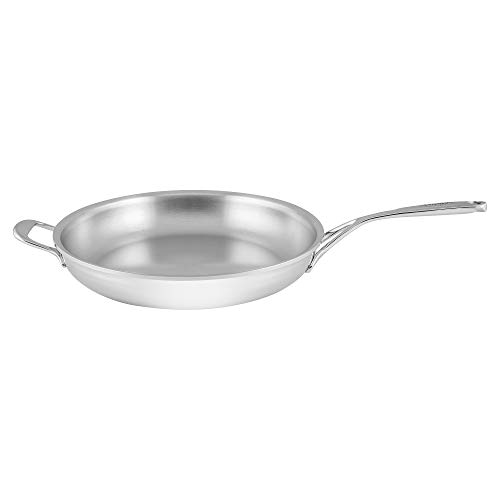
Demeyere Atlantis Proline 12.6-inch Stainless Steel Fry Pan with Helper Handle
Shop at Amazon →This distinction matters because induction cooking is not just about a pan being metal. It has to be the right kind of metal in the right place. Demeyere has long used induction-focused construction, and the company’s technology notes explain how its induction systems are designed for efficiency and control on compatible cooktops.
In use, the biggest practical point is matching the pan to the burner zone. Even a well-made induction pan can heat unevenly if the cooking zone is much smaller than the base. I also think induction rewards restraint: start lower than you think you need, then adjust upward. Because induction reacts quickly, overheating can happen faster than on gas or electric coil.
Common mistakes: using an undersized burner zone, preheating too aggressively, and assuming induction-safe means impossible to scorch.
Some Demeyere constructions include copper in the base or core, though not across every line or every piece. Copper’s role is simple: it transfers heat very quickly, which can make a pan more responsive when you change the burner setting.
That kind of responsiveness is useful for sauces, delicate simmering, and any cooking where you want the pan to react promptly instead of holding onto excess heat. Copper also helps spread heat well, but in this cookware it is generally enclosed within other metals, so you still care for the pan like stainless steel rather than bare copper.
The key thing here is not to assume every piece contains copper. Construction varies, and the presence of copper depends on the specific item. If that feature matters to you, it is worth checking the manufacturer’s materials information rather than relying on general descriptions.
Beyond the core metals, Demeyere also uses a few construction details that affect upkeep and cooking feel.
One is Silvinox, an electrochemical treatment applied to stainless steel. According to the manufacturer’s technology overview, it is meant to help the steel resist dulling and discoloration so it keeps a brighter finish over time. It does not make stainless steel nonstick, but it can make the pan easier to keep looking clean.

Demeyere AluPro 8-inch Aluminum Nonstick Fry Pan
Shop at Amazon →Another is welded handle construction, which means there are no interior rivets. From a cleaning standpoint, that is genuinely useful. A smooth interior is easier to wipe out, and there are fewer corners for grease and cooked-on residue to gather.
These details do not replace the core material story, but they do shape how the cookware feels to live with week after week.
With Demeyere, the arrangement of materials matters as much as the material list itself. A pan with conductive layers running up the sidewalls behaves differently from one with a heat-spreading base bonded only to the bottom.
Fully clad construction brings heat management into the sides of the pan, which helps in wider vessels and recipes where food sits above the center. A bonded base can still perform well, especially for liquids and centered cooking, but the sidewalls play a smaller role.
Layer count also changes the feel of the pan. More layers or thicker conductive assemblies usually mean more heat retention and more stability, but also more weight and slightly slower response when cooling down. Fewer or thinner layers tend to feel quicker and lighter. Neither approach is automatically better; it depends on whether you prioritize searing strength, precise responsiveness, or easy handling.
The best way to protect these materials is also the simplest: use moderate heat, avoid sudden temperature shock, and clean promptly.
Dishwasher safety is not quite the same thing as dishwasher ideal. Some stainless pieces may be dishwasher safe, but manufacturer guidance generally favors hand-washing to preserve the finish. That is especially sensible if you care about appearance or want to avoid detergent haze and spotting.
Another point worth keeping in mind: heavy, well-built cookware is not immune to warping if it is repeatedly overheated or shocked with cold water. A pan can be premium and still suffer from bad habits.
Many stainless steel pieces use 18/10 stainless steel on the cooking surface. That description applies to the food-contact layer, not necessarily every internal layer in the pan.
Yes. Aluminum is commonly used inside the construction to improve heat conduction and reduce hot spots, while stainless steel remains the exposed cooking surface.
Many pieces are designed for induction and include a magnetic stainless steel component needed for compatibility. It is still smart to confirm the individual piece and use a burner zone that matches the pan base.
The difference is the number and arrangement of bonded metal layers. In general, more layers or thicker builds bring more heat retention and weight, while lighter constructions tend to feel more responsive and easier to handle.
Demeyere cookware materials are less about one miracle metal and more about how stainless steel, aluminum, and induction-friendly layers work together. If you understand that stainless gives you durability, aluminum gives you even heat, and the overall layering changes responsiveness and weight, the lineup makes a lot more sense.

Paige Gilmore
Founder of Stripes & Willows — recipe creator, food photographer and stylist. Every guide is written to make honest, useful kitchen decisions easier.
More about Stripes & Willows →This page contains affiliate links. If you buy through them, Stripes & Willows may earn a commission at no extra cost to you — it never affects what we recommend.