Guide
Best Kitchen Thermometers For Thanksgiving Turkey
Our honest guide to best kitchen thermometers for thanksgiving turkey — what actually matters, what to skip, and how to choose well.

Our honest guide to best kitchen thermometers for thanksgiving turkey — what actually matters, what to skip, and how to choose well.
 Best Overall
 Best Plastic Stainless Steel
Also Great
Best Plastic Stainless Steel
Also Great
The best kitchen thermometer for Thanksgiving turkey is usually a two-part approach: a leave-in probe to track progress as the bird roasts, and a digital instant-read thermometer to confirm doneness in a few key spots right before carving. If I had to choose just one, I’d pick an instant-read model because it’s the most flexible, but for a big holiday turkey, a probe thermometer makes the whole day calmer and more predictable.
Turkey is large, uneven, and easy to overcook in one area while another spot lags behind. That is why the best thermometer depends on when and how I want the information.
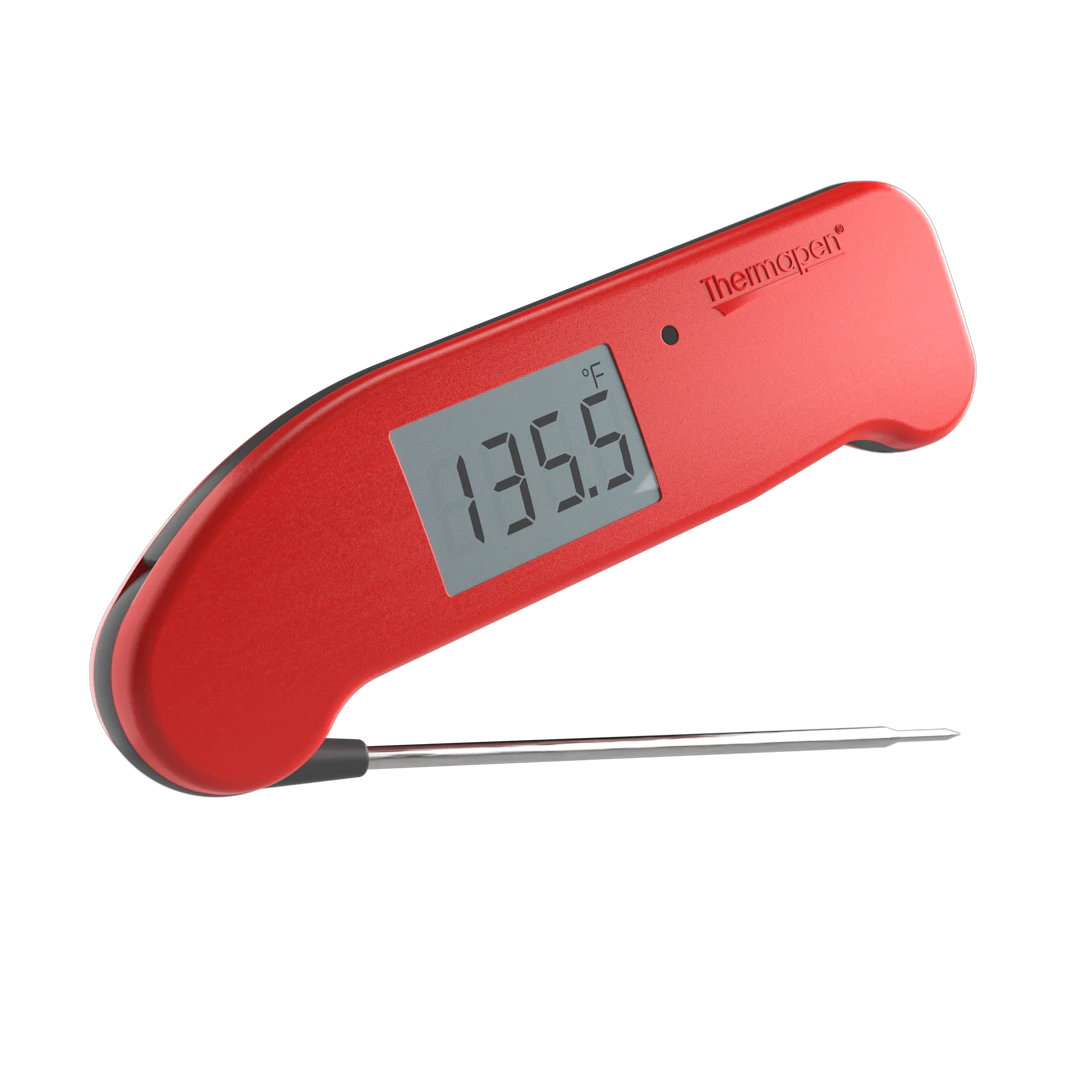
An instant-read thermometer is the most useful final-check tool. It gives a quick reading when I open the oven, and I can move it from the breast to the thigh to the wing without leaving anything in the bird. For Thanksgiving, that matters because one reading is never enough on a whole turkey.
ThermoWorks Thermapen ONE
Shop at thermoworks.com →Also at AmazonA leave-in probe thermometer is the practical choice for hands-off monitoring. The probe stays in the meat while the turkey cooks, and the temperature display sits outside the oven. I like this setup because it cuts down on oven-door opening, which helps the turkey cook more evenly and keeps the schedule from drifting.
Wireless thermometers are especially helpful if the turkey is on a smoker or grill, or if I want to move around the house without hovering near the oven. They are convenient, but I still treat the final reading as something to confirm in several places with an instant-read thermometer.
What I would not rely on is the built-in pop-up timer. It only measures one area, and that one area may not represent the thickest breast or the deepest part of the thigh. The USDA’s Thanksgiving turkey guidance is clear that safe doneness should be checked in multiple locations.
The most important checks are the thickest part of the breast, the innermost thigh, and the inner wing area. If the turkey is stuffed, the center of the stuffing also needs its own reading.
For the breast, I insert the thermometer from the side into the thickest part so the tip reaches the center of the meat without sliding into the cavity. That side entry tends to give a more useful reading than poking straight down from the top.
For the thigh, I aim for the deepest part of the inner thigh where the leg meets the body. This is often the slower-cooking area, so it tells me a lot about whether the turkey is actually ready. I keep the tip away from bone, since bone can distort the reading.
The same rule applies everywhere: avoid bone, avoid the cavity, and avoid shallow placement. If the tip is too close to the surface, I’m only measuring heat near the outside instead of the true internal temperature.
A whole turkey needs more than one check because it cooks unevenly by nature. The breast is lean and can dry out quickly, while the thighs and wings generally need more time. A good thermometer helps me catch that difference before it turns into overcooked white meat.
Turkey should reach 165°F in the thickest part of the breast, the innermost thigh, and the inner wing. If the bird is stuffed, the center of the stuffing also needs to reach 165°F. That is the food-safety baseline I use, and it matches USDA recommendations.
There is a lot of discussion around pulling a turkey at 160°F and letting carryover cooking finish the job. I don’t think that is the best approach for most home cooks on Thanksgiving. Carryover cooking varies with bird size, roasting temperature, pan shape, and resting conditions, so it is less predictable than people make it sound.
Resting does matter, though. After the turkey comes out of the oven, the internal temperature may continue to rise a bit as heat moves inward. I treat that as a bonus, not as a fix for undercooked meat. If a reading is meaningfully below target, the turkey goes back in the oven.
If I’m close to done, I like to check one spot twice. A second nearby reading can tell me if I hit a hot pocket, a cooler patch, or exactly the center of the meat.
For a standard oven-roasted turkey, a leave-in probe with an outside display is the easiest way to monitor progress. It lets me see the temperature without repeatedly opening the oven, and that alone can make the roast more consistent.
DOQAUS Meat Thermometer Digital – Instant Read Food Thermometer for Cooking
Shop at Amazon →For smoked or grilled turkey, a probe or wireless thermometer is even more useful because every lid opening lets out heat. In that setup, I want a probe that is rated for the cooking environment and easy to read from a distance. A final instant-read check is still worth doing before serving.
For deep-fried turkey, the thermometer needs to match the job. The oil itself needs a high-heat thermometer, and the turkey needs a separate food thermometer after frying. I would never assume that a general kitchen probe can go into hot oil unless its instructions explicitly say so.
As for features, I pay attention to readability, probe shape, and response time. A thin probe makes a smaller puncture, and a clear display is easier to use in a crowded kitchen. Fast readings are helpful when I’m checking multiple spots in quick succession. A general kitchen thermometer guide from Real Simple also emphasizes good placement and checking the thickest parts of the bird rather than relying on appearance alone.
A thermometer is only as helpful as its accuracy. Before Thanksgiving, I like to check it in ice water to see if it reads close to 32°F. That quick test can catch a problem before the turkey is in the oven and guests are on the way.
A boiling-water test can also be useful, though I keep elevation in mind because water boils below 212°F at higher altitudes. If a thermometer has a calibration feature, I’d use it according to its instructions. If it is noticeably off and cannot be corrected, it is not the tool I want for a holiday meal.
Cleaning matters too, especially after the probe touches raw turkey. I wash the probe with hot, soapy water, rinse it well, and dry it thoroughly. The handle or display should be cleaned according to its care instructions rather than soaked automatically. Probe cables should be loosely stored, not sharply bent.
This is also one of those tools that rewards a little preparation. If the battery is weak, the display hard to read, or the cable kinked, Thanksgiving morning is not the time I want to find that out.
The biggest mistake is checking only the breast and calling it done. That often leads to a turkey that looks perfect on top while the thigh still needs more time. Then the breast keeps cooking while I wait, and the white meat pays the price.
Efeng Deep Fryer/Candy/Turkey Thermometer with Clip&15 inch stem - Professional Kitchen Pot Fryer,Stainless Steel Fry Oi
Shop at Amazon →Another common mistake is touching bone. If the temperature jumps suddenly or seems unusually high, I pull the thermometer back slightly and try again. Bone conducts heat differently than meat, so it can mislead me.
Measuring the cavity is another issue. Hot air and juices inside the cavity do not tell me what the center of the meat is doing. The same goes for stuffing: if the turkey is stuffed, the center of the stuffing needs its own reading. The National Turkey Federation’s thermometer guidance also notes that both turkey and stuffing should reach 165°F.
Finally, there is the habit of opening the oven over and over again. I try to make one deliberate round of checks near the expected finish instead of repeatedly testing too early. Less poking, less door opening, and better timing usually mean juicier meat.
The best spots are the thickest part of the breast and the innermost part of the thigh, with an extra check near the inner wing. I keep the tip away from bone and the cavity for the most accurate reading.
I recommend pulling it when the key areas reach 165°F. Carryover cooking can raise the temperature a bit during resting, but it is too variable to depend on for food safety.
Both should reach at least 165°F. If the turkey is stuffed, the center of the stuffing should also reach 165°F.
You can’t verify a safe internal temperature with confidence without one. Color, juices, and timing can give clues, but only a thermometer confirms doneness.
For Thanksgiving turkey, I think the smartest setup is a leave-in probe for monitoring and an instant-read thermometer for final checks. The real key is not the gadget itself but using it in the right places and confirming 165°F in every area that matters.

Paige Gilmore
Founder of Stripes & Willows — recipe creator, food photographer and stylist. Every guide is written to make honest, useful kitchen decisions easier.
More about Stripes & Willows →This page contains affiliate links. If you buy through them, Stripes & Willows may earn a commission at no extra cost to you — it never affects what we recommend.
